
Weight × energy
Installed mass, drag and electrical demand affect payload, mission energy and center of gravity.
UIR academic concept · Future vision
A systems-engineering concept for upgrading existing aircraft through lightweight cabins, digital twins, predictive maintenance and propulsion-ready interfaces.
Problem
Operators need lower lifecycle impact, competitive cost, safety, reliability and passenger comfort. Replacement alone is not the only design path, but every retrofit must respect certification, interfaces, mass, downtime, maintainability, cybersecurity and economics.
“How might an existing narrow-body aircraft be upgraded in modular steps while protecting airworthiness and passenger experience?”
Installed mass, drag and electrical demand affect payload, mission energy and center of gravity.
New cabin functions must preserve protection, warnings, emergency operation and human factors.
Installation time, certification effort, spares and training can erase a promising technical benefit.
Repair, reuse, embodied materials and end-of-life pathways belong inside the first trade study.
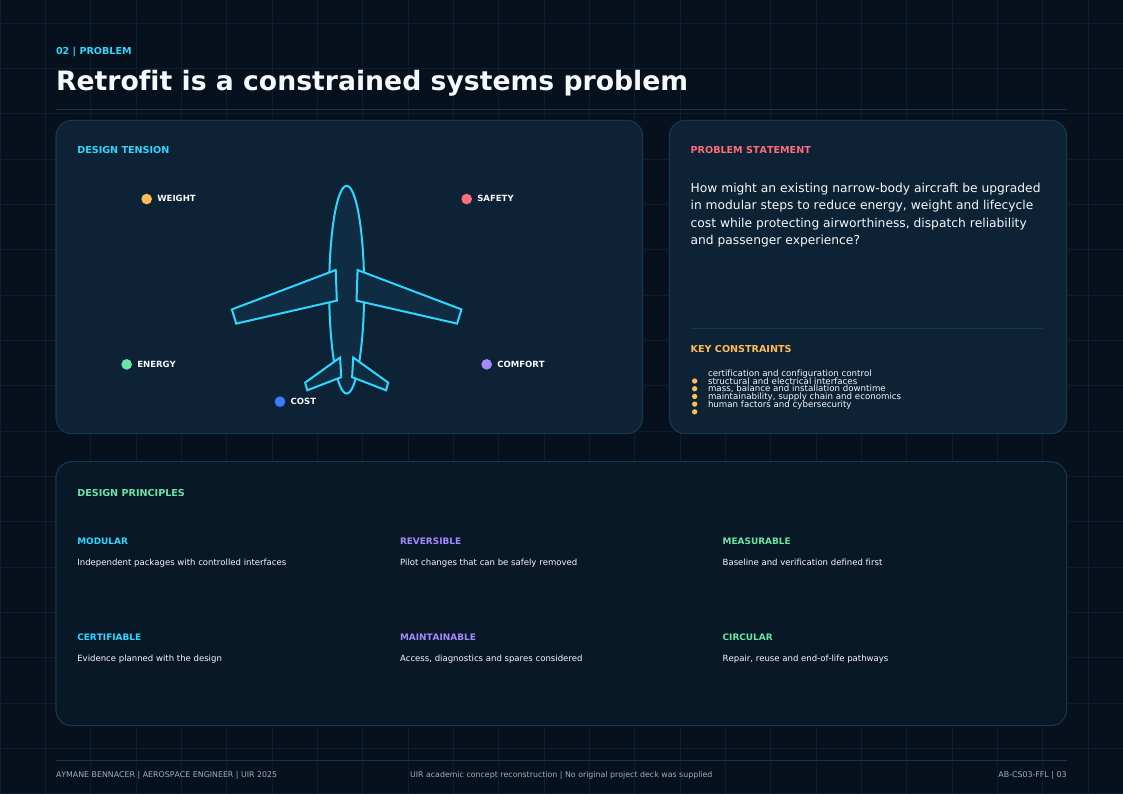
Weight, safety, energy, comfort and cost treated as one system.
Process
Stakeholder needs become testable requirements, module interfaces and verification methods. A digital baseline comes before physical change; safe demonstrators progress from bench to approved aircraft evidence.
Stage 01
Define mission, aircraft configuration, model bounds, assumptions and uncertainty.
Stage 02
Test loads, energy, faults, durability and safe-state behavior.
Stage 03
Validate human factors, installation, access, repair and turnaround tasks.
Stage 04
Integrate power, data, cooling, software and fault containment.
Stage 05
Perform approved installation checks and configuration review.
Stage 06
Proceed only inside an approved program with authorized personnel.
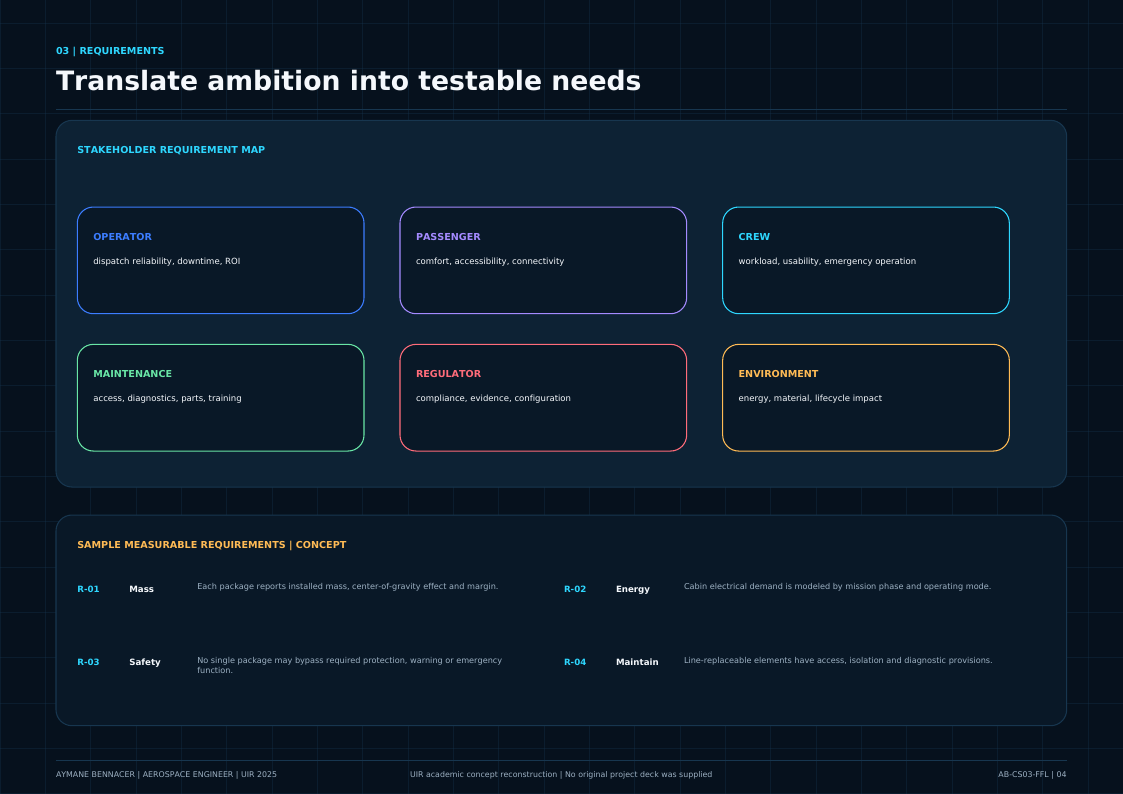
Operator, passenger, crew, maintenance, regulator and environment.
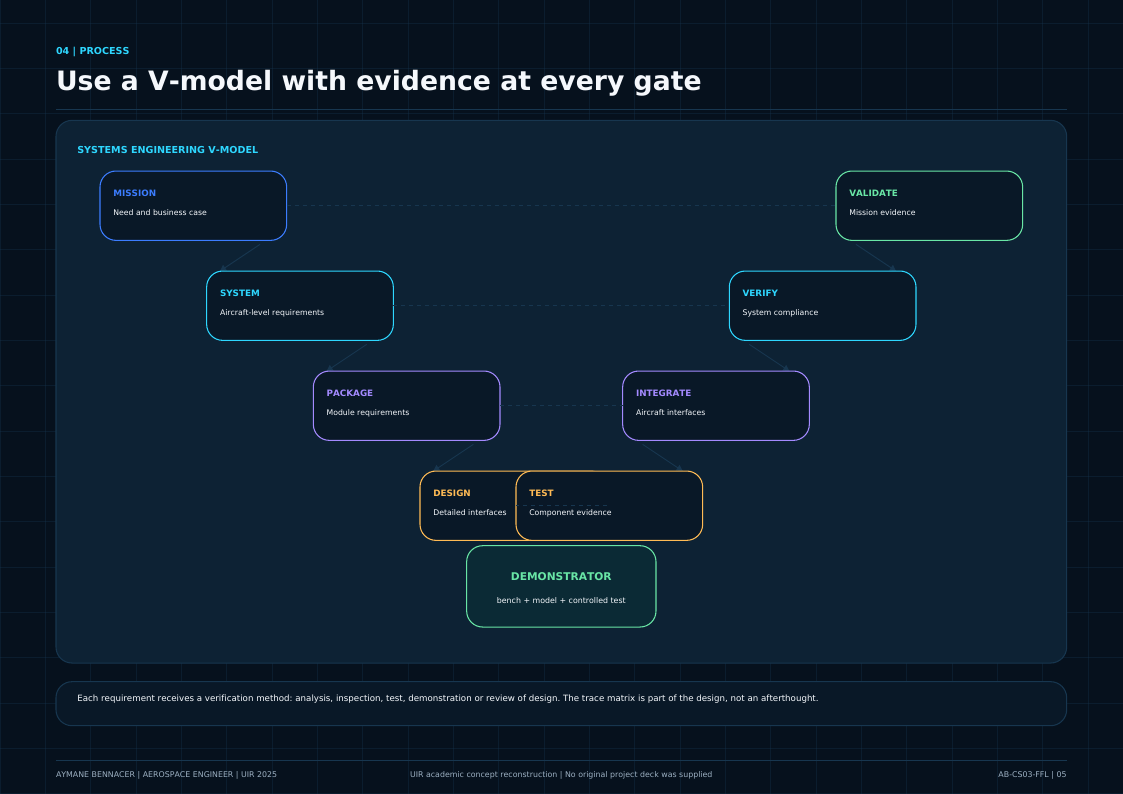
Every requirement receives a verification method and exit gate.
Solution
Five upgrade modules share controlled structural, power, data, cooling, software, maintenance, human-factors and certification interfaces. Mature, measurable packages enter first; high-certification-burden propulsion changes remain in a research track.
Repairable panels, seats and monuments designed around mass, access and end-of-life recovery.
Zonal power, lighting and air-quality sensing with degraded modes and measurable passenger benefit.
Selected condition signals translated into maintenance insight with uncertainty and human authorization.
A secure digital backbone and staged technology interfaces without pretending early concepts are certified changes.
LIVE PORTFOLIO MODEL
Synthetic portfolio data—replace with verified project records before public use.
Measurement plan · targets, not results
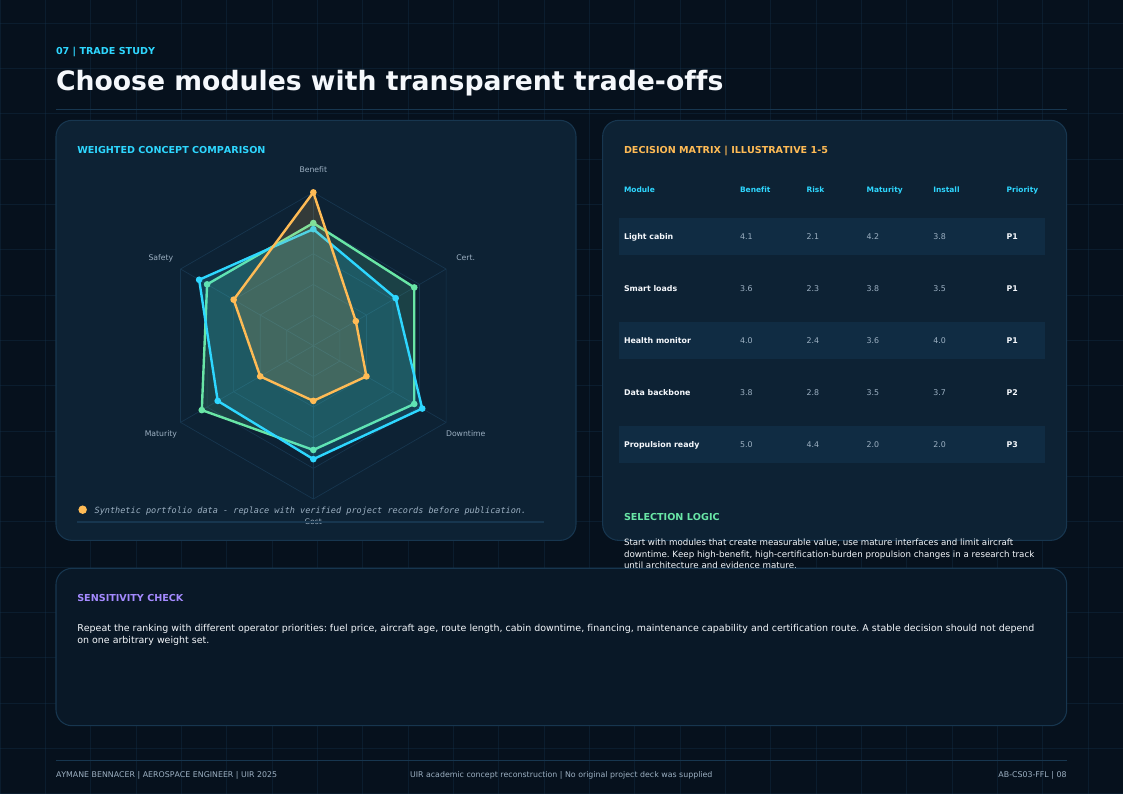
A go/no-go decision must survive conservative assumptions for downtime, certification cost, residual value, training, spares, fleet commonality and lifecycle uncertainty.
Evidence
The web story keeps the document’s words, engineering logic and visual evidence—then lets the reader move through them at their own speed.
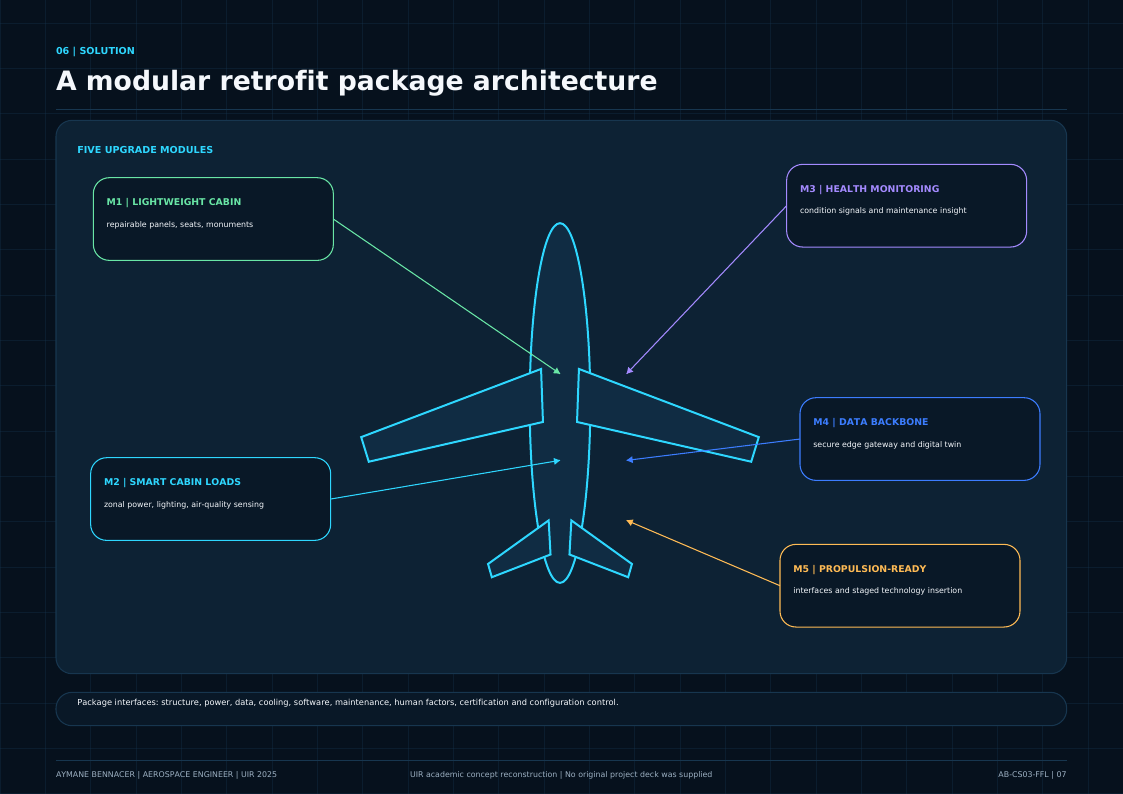 Open visual
Independent packages joined by controlled aircraft interfaces.
 Open visual
Benefit, risk, maturity, installation and sensitivity compared.
 Open visual
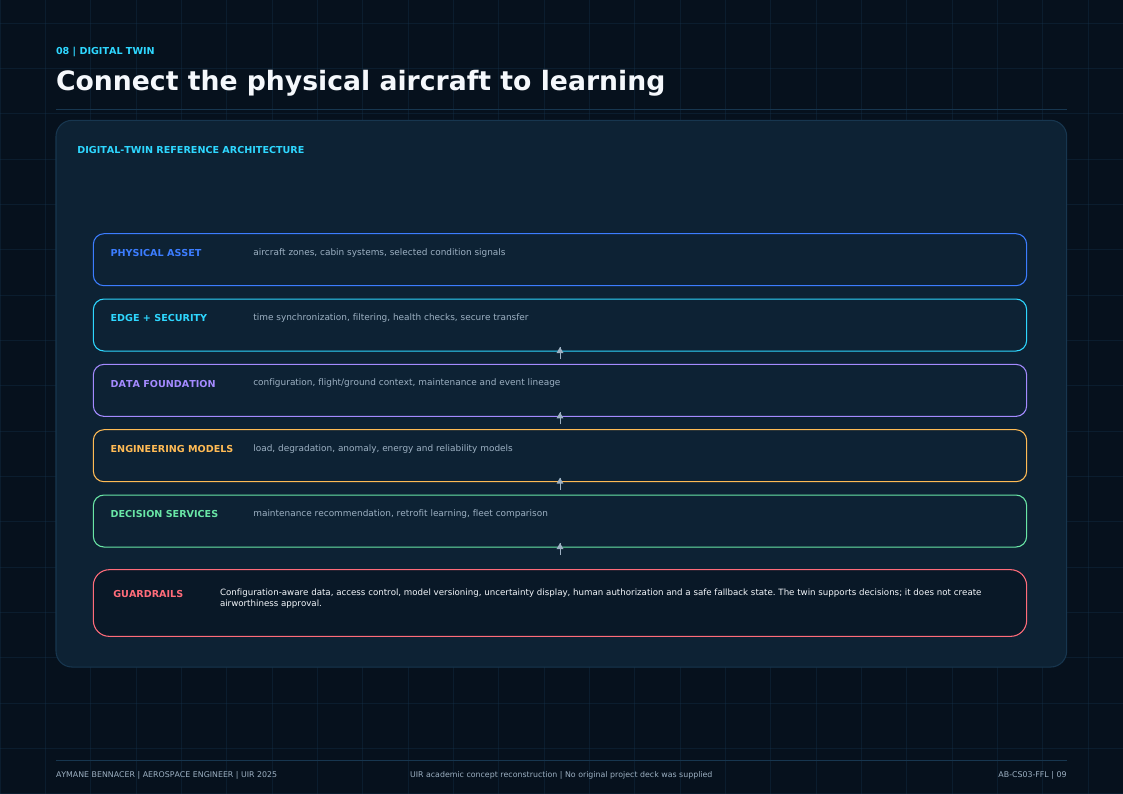
Physical asset, secure edge, evidence foundation, models and decisions.
 Open visual
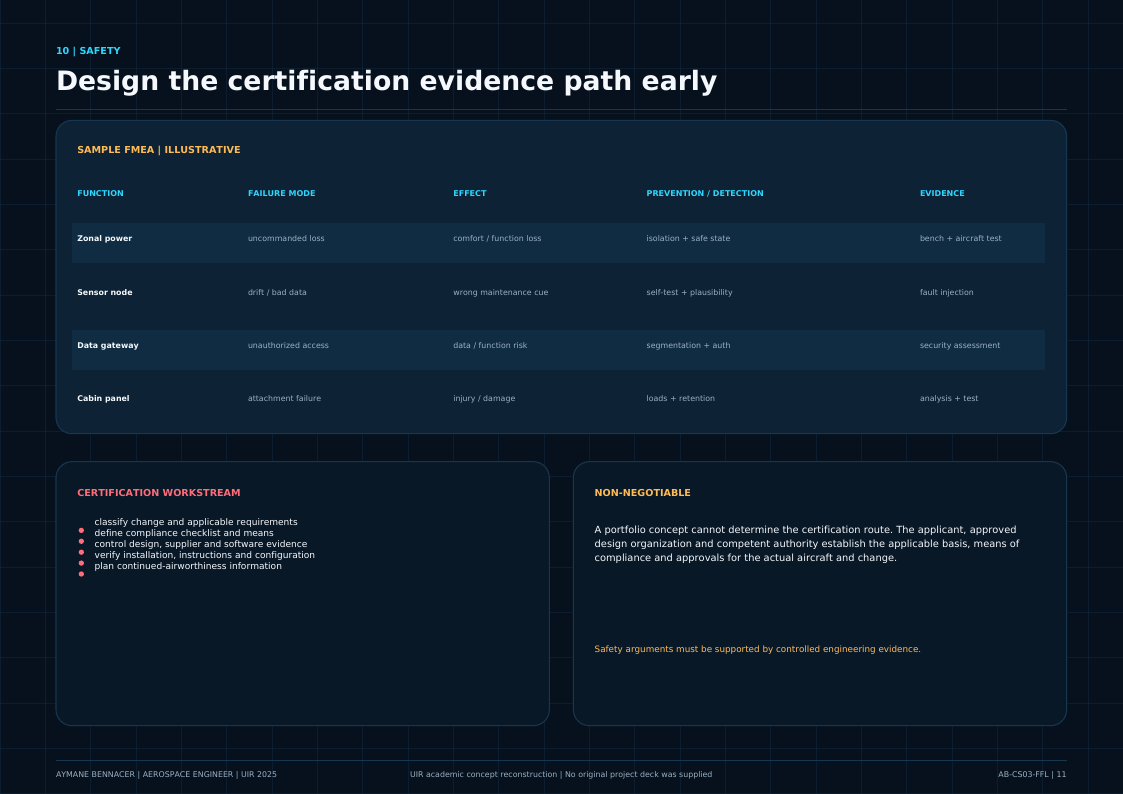
Illustrative failure modes plus an early compliance workstream.
The original school-project PPT was not supplied. This is explicitly a concept reconstruction based on Aymane’s stated future vision—not a claim of completed UIR calculations, prototypes or test results.